thumb 1
Product

Herbicides

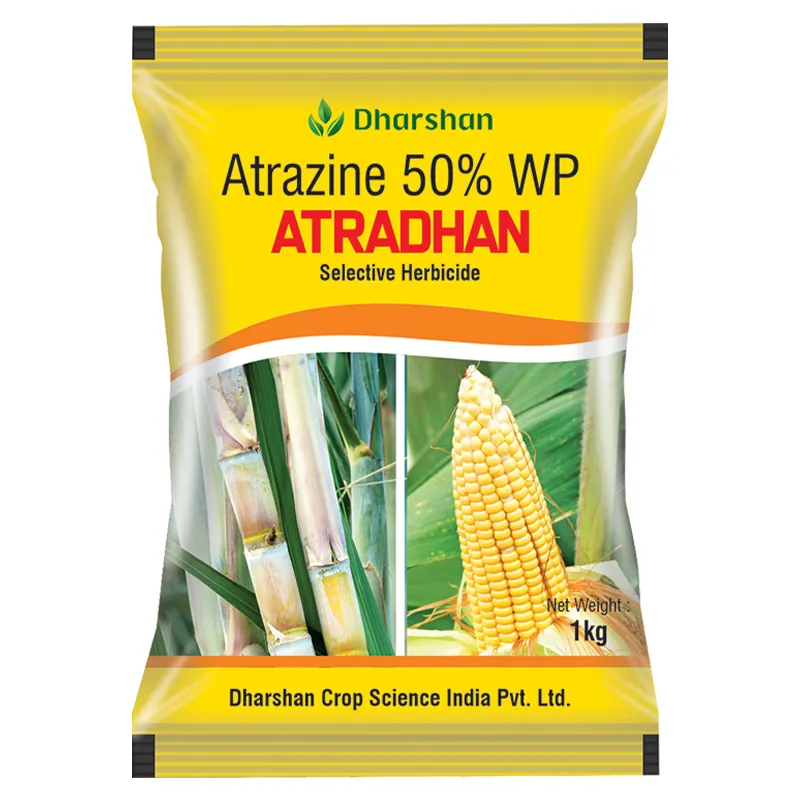
Atradhan

Atrazine 50% WP

Brand: Dharshan Crop Science India Pvt Ltd

Recommended Crops

  • Maize
  • Sugarcane
  • Potato

Atradhan Atrazine 50% WP – Selective Systemic Herbicide (Pre & Post-Emergence) Atradhan is a selective, systemic herbicide containing Atrazine 50% WP. Widely used in maize and sugarcane fields, it provides effective control of grasses and broadleaf weeds by inhibiting photosynthesis. Atradhan can be applied as both pre-emergence and post-emergence, ensuring flexible and long-lasting weed management.

Atradhan Atrazine 50% WP – Selective Systemic Herbicide (Pre & Post-Emergence) Atradhan is a selective, systemic herbicide containing Atrazine 50% WP. Widely used in maize and sugarcane fields, it provides effective control of grasses and broadleaf weeds by inhibiting photosynthesis. Atradhan can be applied as both pre-emergence and post-emergence, ensuring flexible and long-lasting weed management.

  • Technical Name: Atrazine 50% WP
  • Mode of Entry: Selective and Systemic in action. It is for both pre and targeted post emergence applications which belong to the Triazine group.
  • Mode of Action: Atrazine works by inhibiting photosynthesis by binding with the DI protein site at photosystem II. It also inhibits the enzymatic activity in the targeted weeds. Lack of photosynthesis results in the death of treated plants.
  • ATRADHAN Herbicide effectively controls grassy and broad-leaved weeds.
  • It Provides a longer period of protection of crops against weeds.
  • It is safe for the environment and care should be taken to avoid drift in water ways.
  • ATRADHAN is highly cost effective and plays an important role managing the resistant weeds.
  • Crops: Maize, Sugarcane, Potato, and other recommended field crops.
  • Target Weeds: Annual grasses and broad-leaved weeds.

Crops

Target Weeds

Dosage / Acre (gm)

Dilution in water (L/Acre)

Sugarcane

Digiteria spp., Boerhaavia diffusa, Euphorbia spp., Tribulus terrestris, Portulaca oleracea.

400-1600

200

Maize

Trianthema monogyna, Digeria arvensis, Enchinochloa sp., Digitaria, Xanthium strumariam, Amaranthus viridis, Cleome viscosa, Polygonum spp.

400-800

200